
.NET vs Other Frameworks: Strategic Reasons Why Businesses Prefer It?
Modern enterprises operate in a digital environment where software performance directly affects business success. Applications must handle millions of users, large data volumes, and complex integrations while maintaining strict security and compliance standards. This is why many organizations evaluate development frameworks carefully before committing to a technology stack. Among the most widely adopted enterprise platforms, .NET consistently stands out for scalability, reliability, and long-term enterprise support.
Many organizations exploring this technology also examine the broader strategic advantages of .NET in enterprise environments. A deeper explanation of these advantages is discussed in Why Enterprises Choose .NET for Scalable, Secure & High-Performance Systems?, which explains how .NET supports enterprise-grade performance and infrastructure reliability.
The Enterprise Reality Check: Why “Good Enough” Systems Collapse at Scale
Enterprise software systems must perform flawlessly under heavy workloads. Platforms used in finance, healthcare, and global e-commerce cannot tolerate slow response times or system failures. As businesses grow, technology that once worked efficiently may begin to struggle with increased demand.
Organizations therefore require development frameworks designed for long-term scalability and performance rather than short-term functionality.
The One-Second Rule
Even minor performance delays can significantly affect enterprise operations. Studies show that a one-second delay in response time can reduce conversions and increase customer abandonment.
For large organizations, downtime or latency can result in:
- Loss of revenue during peak transactions
- Reduced customer trust and brand credibility
- Operational disruptions across departments
- Increased recovery and maintenance costs
High-performance engineering is therefore not optional – it is essential.
The Enterprise Paradox
Enterprises face a difficult balance between competing technology requirements. Systems must be capable of handling large-scale workloads while maintaining speed, security, and compliance.
Organizations must manage challenges such as:
- Massive scalability while maintaining near-zero downtime
- High transaction volume with instant response time
- Rapid product innovation with strict regulatory compliance
These complex requirements are one reason many businesses rely on the .NET platform.
Why Global Enterprises Choose .NET?
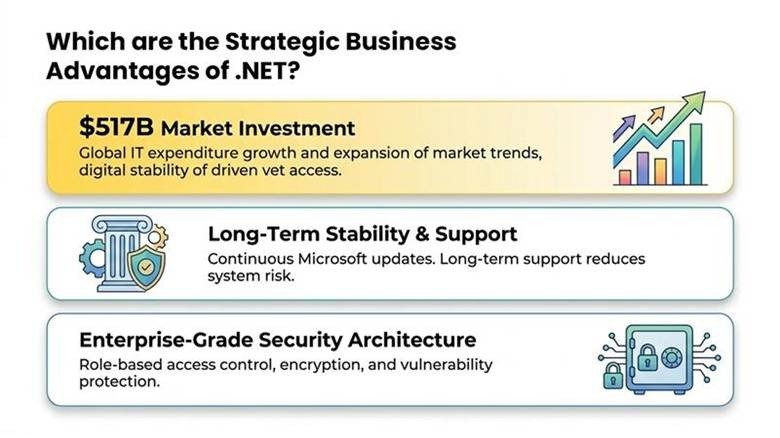
.NET has earned strong enterprise trust because it is backed by Microsoft’s long-term development and support ecosystem. Organizations building mission-critical platforms require a framework that evolves alongside modern technology trends.
Several factors contribute to .NET’s popularity among enterprises:
- Strong enterprise-grade development ecosystem
- Long-term support and stability from Microsoft
- Robust security frameworks built into the platform
- High performance across cloud and hybrid infrastructures
If scalability and security rarely coexist in traditional systems, the question naturally arises: how does .NET manage to deliver both effectively?
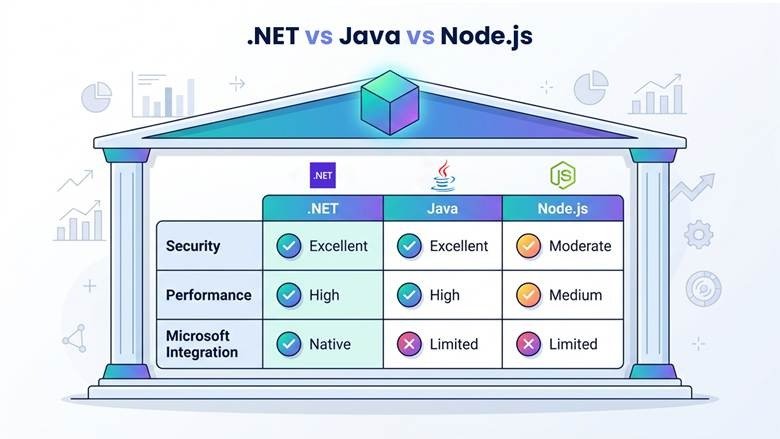
.NET vs Other Enterprise Frameworks: Strategic Comparison
Choosing the right development framework is one of the most important decisions organizations make when building enterprise systems. Businesses often compare .NET with other widely used technologies such as Java and Node.js before selecting a development platform.
While each framework has its strengths, .NET provides several strategic advantages that make it particularly well suited for enterprise environments.
.NET vs Java (Enterprise Ecosystem)
Java has long been a popular enterprise development platform, especially for large-scale applications. However, .NET has evolved significantly in recent years and now offers comparable, and in many cases superior, enterprise capabilities.
Some of the advantages of .NET include:
- Strong integration with Microsoft enterprise tools
- Seamless Azure cloud compatibility
- Faster development with modern frameworks
- Improved performance optimization through runtime enhancements
Organizations already using Microsoft technologies often find .NET easier to integrate into their existing infrastructure.
.NET vs Node.js (Performance and Scalability)
Node.js is known for its lightweight architecture and ability to handle asynchronous workloads efficiently. It is often used for real-time applications such as chat systems or streaming services.
However, enterprise environments typically require more structured frameworks and long-term support.
In comparison, .NET offers:
- More robust enterprise security features
- Better support for complex enterprise architectures
- Strong governance and compliance frameworks
- Greater ecosystem maturity for enterprise-scale applications
These capabilities make .NET particularly attractive for organizations building mission-critical platforms.
Key Enterprise Decision Factors
When comparing development frameworks, enterprise leaders typically focus on several strategic considerations.
These include:
- Long-term platform support and stability
- Performance under heavy workloads
- Built-in security governance
- Ecosystem maturity and integration capabilities
.NET consistently performs well across all of these areas, making it a reliable choice for long-term enterprise technology investments.
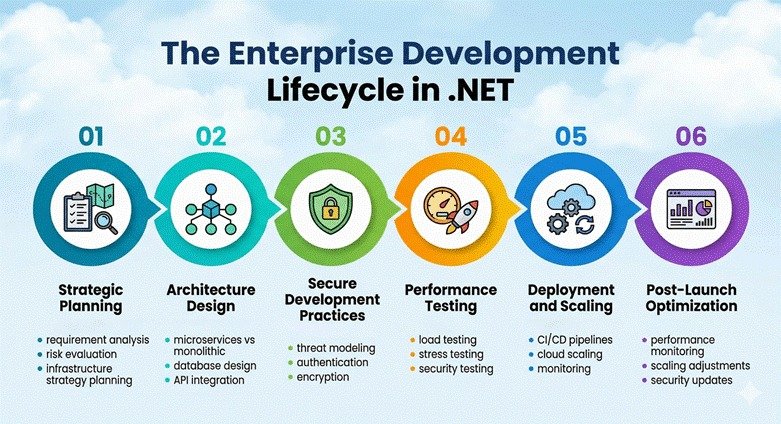
The Enterprise Development Lifecycle in .NET
Developing enterprise systems requires a structured lifecycle that ensures reliability, scalability, and security throughout the development process. The .NET ecosystem supports each stage of this lifecycle through specialized tools and frameworks.
Organizations seeking scalable enterprise platforms often combine these lifecycle practices with advanced development strategies such as enterprise-level architectures and secure custom software development solutions. These approaches help businesses design applications that integrate seamlessly with existing systems while remaining flexible enough to support future growth.
Strategic Planning
Enterprise development begins with careful planning. Organizations must define business goals, system requirements, and infrastructure needs before development begins.
Planning activities typically include:
- Requirement analysis
- Risk evaluation
- Infrastructure strategy planning
Proper planning helps ensure the technology stack supports long-term business objectives.
Architecture Design
Once planning is complete, developers design system architecture that determines how applications will function and scale.
Key architectural considerations include:
- Microservices vs monolithic architecture
- Database design and data flow
- API integration strategies
A well-designed architecture allows enterprise systems to scale efficiently while maintaining system reliability.
Secure Development Practices
Security is integrated throughout the development lifecycle. .NET development frameworks include features that help developers implement secure coding practices from the beginning.
Security practices often involve:
- Threat modeling and vulnerability analysis
- Secure authentication mechanisms
- Encryption and data protection strategies
These measures help organizations reduce cybersecurity risks and maintain regulatory compliance.
Performance Testing
Before deployment, enterprise systems must undergo extensive performance testing to ensure they can handle real-world workloads.
Testing processes typically include:
- Load testing to simulate heavy user traffic
- Stress testing to identify system limits
- Security testing to detect vulnerabilities
This ensures systems remain stable even under extreme demand.
Deployment and Scaling
Once applications are tested and optimized, they are deployed to production environments. Modern enterprise systems rely on automated deployment pipelines to ensure consistent releases and minimize human error.
Deployment strategies often involve:
- Continuous integration and continuous deployment pipelines
- Cloud-based infrastructure scaling
- Automated monitoring and system health checks
Post-Launch Optimization
Enterprise systems continue to evolve after launch. Monitoring tools and analytics platforms help organizations identify performance improvements and new feature opportunities.
Post-launch activities may include:
- Performance monitoring and optimization
- Infrastructure scaling adjustments
- Continuous security updates
This ongoing improvement process helps enterprises maintain competitive digital platforms.
Future-Proofing Enterprise Systems Beyond 2026
Technology continues to evolve rapidly, and enterprise platforms must remain adaptable to emerging innovations. Organizations building enterprise systems today must consider future trends that will shape digital infrastructure.
Several technologies are expected to play a significant role in the future of enterprise development.
Serverless and Edge Computing
Serverless architecture allows organizations to run applications without managing traditional infrastructure. Combined with edge computing, this approach enables faster data processing closer to end users.
Cloud-Native Microservices
Microservices architectures continue to dominate modern enterprise platforms. These systems allow organizations to update individual services without disrupting entire applications.
AI-First Enterprise Platforms
Artificial intelligence is becoming an essential part of enterprise software. Platforms that integrate AI capabilities can automate processes, improve decision-making, and enhance user experiences.
Zero-Trust Security Models
Cybersecurity threats continue to grow in sophistication. Zero-trust security frameworks are becoming standard in enterprise environments because they continuously verify access and limit unauthorized activity.
Conclusion: Building Systems That Endure Market Disruption
Choosing the right development framework is one of the most important technology decisions an enterprise can make. Businesses require platforms capable of supporting massive scale, maintaining strict security standards, and evolving alongside emerging technologies.
.NET has proven itself as a powerful enterprise development platform because it delivers the three qualities modern organizations require most: scalability, security, and long-term reliability.
Rather than being just a development framework, .NET represents a strategic infrastructure decision that enables organizations to build resilient systems capable of supporting innovation and growth.
Enterprise systems today are not simply built to handle current demand. They must be engineered to adapt to the uncertainty and technological transformation that will define the digital economy of tomorrow.