
How AI/ML Development Services Turn Social Trends Into Marketing Insights
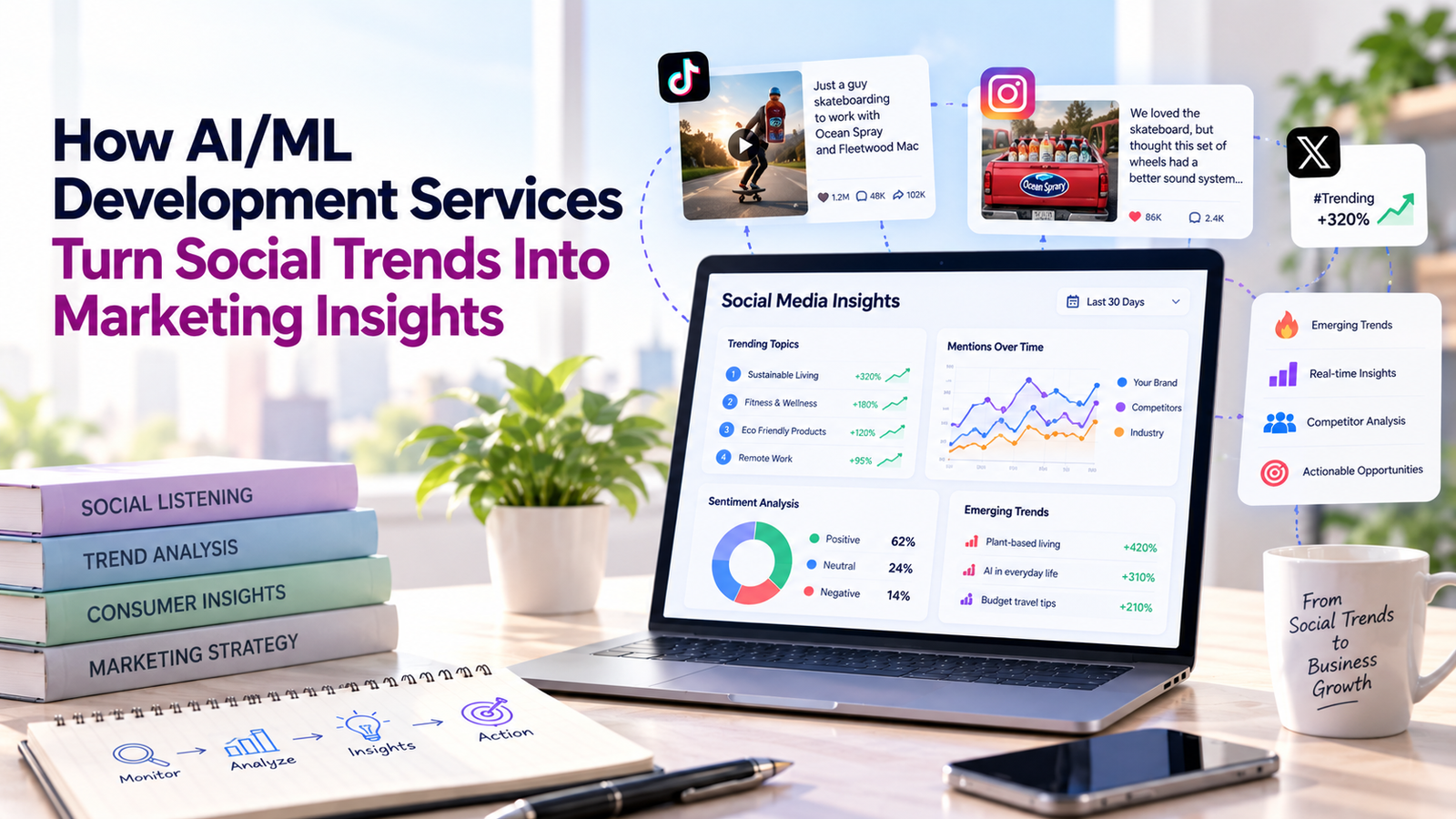
In September 2020, a guy skateboarded to work on TikTok, sipping Ocean Spray, with Fleetwood Mac playing. His car had died, so that’s how he got there. And that was the entire video. No script, no plot. Within about a week “Dreams” had 8.47 million on-demand streams in the US (that’s Billboard’s number), and Ocean Spray, to its credit, jumped in. Its Instagram reply: “We loved the skateboard, but thought this set of wheels had a better sound system…” Then it drove a new truck, bed full of juice, up to his house. The CEO recreated the video. Mick Fleetwood joined TikTok just to do it too.
Now ask yourself how many brands would’ve caught that in time. Most hear about these things in a group chat, a week late, and by then it’s over. That’s where AI/ML Development Services can help, by spotting emerging trends before the moment passes.
What the Software Actually Does
So what’s the fix? Software that reads far more posts than any team could, and works out which topics are getting bigger. That’s pretty much it.
The usual open-source recipe (BERTopic is the well-known one) goes like this. Every post becomes numbers that capture its meaning. Those numbers get squashed into something manageable. Neighbors get grouped, and each group is labeled with its most telling words. Each step has its own jargon, which you can look up if you’re curious. It won’t come up at dinner.
Anything that fits no group lands in an outlier pile, and honestly, it’s worth skimming that pile now and then, because a brand-new trend looks like an outlier until enough people have posted about it.
Then you add time. Every week the system checks which groups grew. A group that doubles week after week? Strong signal. One that flares for three days and fades? Noise. Forecasting stays pretty basic (Prophet, ARIMA, that sort of thing), because social data’s messy, and feeding a fancy model messy data just gets you fancy mistakes.
What a Marketing Team Gets
Early warning, mostly. And a better picture of how people talk about you next to your rivals, split by subject rather than one big score.
That split matters more than it sounds. “72% positive” tells you nothing. “People love the product but keep griping about delivery” tells you where the money goes. Newer sentiment models try to catch emotion and intent too, so “furious about delivery” and “mildly annoyed about packaging” don’t both land in “negative.”
Say you sell trainers online. The system flags a cluster of posts about “sizing runs small,” growing for three weeks. Nobody on your team had noticed, because every complaint was buried in a different thread. So now you update the size guide, tell customer service, maybe warn the buyer before the next order. Not glamorous. Just earlier than a human would’ve caught it. That’s what good AI ML development gets you.
Getting the Data
This kills more projects than any model problem. The data’s hard to get, and it’s getting harder.
X moved new developers to pay-per-use in early 2026, with a monthly cap on reads and the full archive locked behind contracts costing tens of thousands a month (guides disagree on exact rates, so check before budgeting). Meta’s content library is free but meant for approved researchers. TikTok’s research tools are for academics, and one guide says the data lags by a day to a week.
So most marketing teams end up buying from licensed data vendors, or using the business tools each platform gives you for your own accounts. A sensible AI/ML Development Services partner raises this in week one, because it decides what you can build at all.
Where It Falls Over
Sarcasm, mostly. “Great, another delay” looks positive if all you see is the words. Accuracy drops outside English too, and when a vendor quotes 90%-plus, that’s their own lab test, not your data.
Bots muddy things (one older analysis put nearly 10% of the posts brands study as not coming from real people, though that number’s probably moved), and a handful of hyperactive accounts can swamp a keyword sample until a fringe view looks mainstream.
None of that means it doesn’t work. It means somebody checks the output, especially the calls the model’s unsure about. A serious AI ML development team will test on your own posts before trusting a vendor’s number. And a public post tied to a real person can still be personal data, so keep handles out of reports.
AI/ML Development Services or an Off-the-Shelf Tool?
Platforms like Brandwatch and Ipsos Synthesio do this already, and for plenty of teams one of them’s the right call. Custom work earns its place when your market has its own slang, when the output has to feed your own systems, or when off-the-shelf sentiment keeps getting your niche wrong.
That’s where AI ML development partners come in, and the good ones start from the decision the insight feeds, not the model. If nobody can say what marketing would do differently after seeing a trend, no model fixes that. Start small: one product line, a couple of data sources, and a short list of questions the marketing lead really wants answered.
BiztechCS, which delivers AI/ML Development and GenAI Solutions for mid-market businesses, tends to start with the workflow and the data and leave the model for last. Slower to scope, but more likely to get used.
A trend report nobody acts on is just another dashboard.