
How to Budget for Commercial Beer Brewing Equipment
Opening a commercial brewery is an exercise in balancing the art of fermentation with the cold, hard reality of financial planning. For the aspiring brewery owner, the equipment list is often the single largest line item in the startup budget. In 2026, as the craft beer industry continues to mature and consumer expectations for quality reach an all-time high, the “cost of entry” has become more nuanced.
Budgeting for a brewery is not simply about checking the price of a stainless steel tank. It involves a holistic view of the entire production lifecycle—from grain handling to waste management—and the infrastructure required to support it. This guide provides a comprehensive breakdown of how to build a realistic, resilient budget for your commercial brewing hardware.
1. Determining Your Production Scale and Philosophy
The first step in any budget is defining the scale. In the brewing world, size dictates cost in a non-linear fashion. A 10 BBL (barrel) system does not cost exactly twice as much as a 5 BBL system, but it will significantly increase your utility and space requirements.
The Brewpub Model (3 BBL – 7 BBL)
If your primary revenue comes from over-the-counter sales in your own taproom, a smaller system is often more budget-friendly. This allows for more frequent brewing and a fresher, rotating tap list.
- Budget Range: $80,000 – $150,000 (Equipment only).
The Production/Distribution Model (15 BBL – 30 BBL+)
If you plan to sell cans or kegs to grocery stores and bars, you need volume. Large-scale equipment requires higher ceilings, reinforced floors, and a significantly larger budget for automated packaging.
- Budget Range: $250,000 – $600,000+.
2. The Brewhouse: The Heart of the Investment
The brewhouse is your most visible asset. When budgeting for these vessels, you must decide between different heating sources and configurations.
Heating Methods and Costs
- Steam: The gold standard for consistency. It requires a steam boiler, which adds $30,000 to $50,000 to the budget, but it offers the best ROI through energy efficiency and speed.
- Electric: Popular for systems under 7 BBL. It is cheaper to install initially but can lead to high monthly electricity bills depending on your local rates.
- Direct Fire: Uses gas burners. It is middle-of-the-road in cost but can be harder to clean if the wort “scorches” on the bottom of the kettle.
Vessel Configuration
A two-vessel system (Mash/Lauter and Kettle/Whirlpool) is the baseline. However, if you plan to brew multiple times a day (back-to-back brewing), budgeting for a three-vessel or four-vessel system is a wise investment. It increases your throughput without requiring a larger building.
3. The Cellar: Where Your Beer Lives
You can brew a batch of beer in eight hours, but it will occupy a fermenter for two to three weeks. Therefore, your cellar budget must be flexible enough to grow as your sales increase.
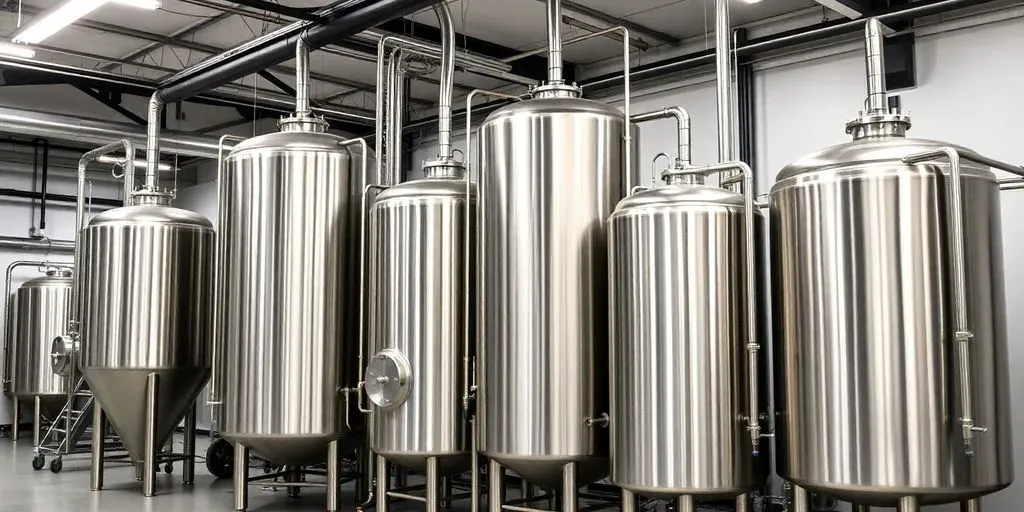
Fermentation Tanks (Unitanks)
Unitanks are jacketed and pressure-rated, allowing you to ferment and carbonate in one vessel.
- Budgeting Tip: Always purchase at least one or two “double-sized” fermenters (e.g., if you have a 10 BBL brewhouse, buy a 20 BBL fermenter). This allows you to brew twice in one day and fill a larger tank, which is more cost-effective per gallon of beer produced.
Brite Beer Tanks (BBTs)
While many modern brewers serve directly from Unitanks, having a dedicated Brite tank for clarification and carbonation frees up your fermenters faster. Budget for at least one BBT for every three fermenters.
4. The “Hidden” Utility Infrastructure
This is the area where most brewery budgets fail. The equipment doesn’t just sit on the floor; it needs a complex web of support systems.
Glycol Cooling Systems
To control fermentation temperatures, you need a commercial glycol chiller. This unit pumps food-grade antifreeze through the tank jackets.
- Budgeting Rule: Never buy a chiller that is “just big enough.” Budget for a unit that can handle twice your initial tank count to allow for expansion. Expect to spend $20,000 to $45,000.
Flooring and Drainage
Standard concrete will be eaten away by brewery chemicals and thermal shock (hot water hitting cold floors). You must budget for urethane cement flooring and high-capacity trench drains.
- Estimated Cost: $12 to $18 per square foot.
Water Filtration
Beer is 90% water. If your municipal water is high in chlorine or minerals, your beer will suffer. A commercial Reverse Osmosis (RO) or carbon filtration system should be budgeted at $5,000 to $12,000.
5. Grain Handling and Milling
Moving hundreds of pounds of malt per day by hand is a recipe for injury and inconsistency.
- The Mill: Budget for an explosion-proof motor to meet safety codes.
- Augers and Grist Cases: These move the grain from the mill to the mash tun automatically. For a 10 BBL+ system, this is a non-negotiable budget item, costing roughly $8,000 to $15,000.
6. Packaging: Cans, Bottles, and Kegs
Getting the beer to the customer is the final hurdle.
- Kegs: You need a “keg-to-production” ratio of at least 3:1. For every keg being poured, one is in transit and one is being cleaned. At $110 per keg, a small fleet can easily cost $20,000.
- Canning Lines: In 2026, cans are king. A small-scale, semi-automatic canning line will start at $60,000. If you want a fully automated line with date coding and labeling, budget $120,000+.
7. Soft Costs: Shipping, Installation, and Commissions
The price on the manufacturer’s quote is rarely the final cost.
- Freight: Shipping several tons of stainless steel can cost $10,000 to $25,000 depending on the distance.
- Rigging: You will need to hire a specialized crew with forklifts or cranes to stand the tanks up and place them. Budget $5,000 to $8,000.
- Professional Fees: You will need a plumber for glycol lines, an electrician for the control panels, and potentially a structural engineer for floor loading. Budget an additional 15% to 20% of your total equipment cost for installation.
8. Creating a Contingency Fund
No brewery build-out goes exactly to plan. In 2026, supply chain fluctuations and labor shortages can lead to unexpected delays. A 15% contingency fund is the difference between a successful launch and a project that stalls six inches from the finish line. If your total equipment budget is $300,000, you should have $45,000 set aside for the “unknowns”—like a valve that breaks during installation or a city inspector requiring a last-minute change to your ventilation.
9. Strategies for Reducing Costs Without Sacrificing Quality
While it is tempting to buy the cheapest equipment available, this often leads to higher costs down the road in the form of lost batches and equipment failure. Instead, consider these strategies:
- Buy Larger Vessels Early: It is cheaper to buy a 20 BBL fermenter now than to buy a 10 BBL now and another 10 BBL next year.
- Phase Your Packaging: Start with kegs for the taproom and hire a mobile canning service for your first few retail releases. This allows you to delay the $100,000+ investment in a canning line until you have proven the brand.
- Manual vs. Automated: You can save $40,000 by opting for manual valves instead of pneumatic ones. You will spend more on labor, but it reduces your initial capital outlay.
Why Choose Micet for Your Brewery Budget?
When you are ready to turn your budget into reality, choosing a manufacturer that offers both value and high-end engineering is critical. Micet has built a global reputation for delivering professional-grade brewing equipment that meets the rigorous standards of modern craft beer production without the “brand-name” markup of some domestic manufacturers.
The Micet Advantage:
- Precision Engineering: Micet utilizes certified 304/316L stainless steel with high-precision TIG welding and mirror-polished interiors to ensure maximum sanitation and durability.
- Turnkey Solutions: Micet can provide everything from the grain mill to the canning line, ensuring that every piece of equipment is designed to work together seamlessly. This reduces your installation and integration costs.
- Customization: Their engineering team works with you to design a system that fits your specific building constraints, helping you maximize your floor space—and your budget.
- Expert Support: From initial CAD drawings to technical support during installation, Micet provides the professional partnership needed to move from a business plan to a flowing tap.
By choosing Micet, you are investing in equipment that is built to last, allowing you to focus your budget on what matters most: brewing exceptional beer.
Frequently Asked Questions
1. How much should I budget per barrel of production for equipment?
While it varies, a good “rule of thumb” for 2026 is to budget between $25,000 and $40,000 per barrel of brewhouse capacity for a complete, professional setup. For example, a 10 BBL brewery typically requires a total equipment investment of $250,000 to $400,000, depending on the level of automation and packaging.
2. Should I buy used equipment to save money?
Used equipment can save you 30% to 50% upfront, but it comes with risks. You often don’t have a warranty, and you may inherit “hidden” issues like compromised cooling jackets or poor sanitation history. For critical items like your brewhouse and fermenters, new equipment from a reliable manufacturer like Micet often provides a better long-term ROI due to reliability and efficiency.
3. What is the most expensive “forgotten” item in a brewery budget?
The glycol piping and installation is frequently underestimated. While the chiller unit might cost $25,000, the insulated copper or ABS piping, manifolds, and professional labor to connect it to every tank in your cellar can easily add another $15,000 to $20,000 to the project.