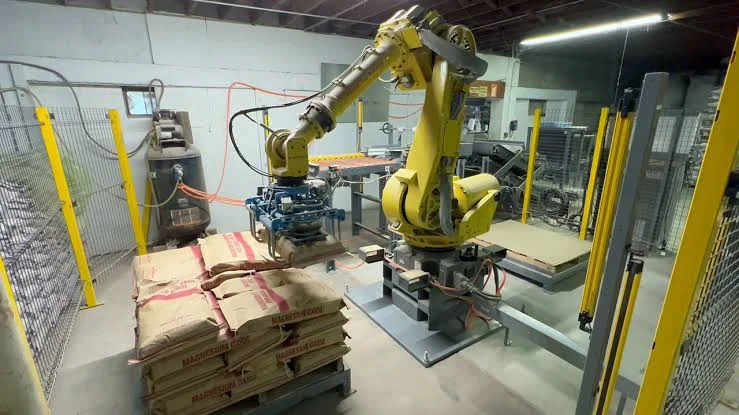
Across warehousing, food processing, consumer goods, and industrial manufacturing, the decision to automate end-of-line palletizing has moved from a long-term capital conversation to an operational necessity. Labor shortages, repetitive strain injury claims, inconsistent stack quality, and throughput pressure have pushed plant managers and operations directors to evaluate automation more seriously than at any point in the last decade.
But the gap between what vendors promise and what facilities actually experience during integration is wide enough to derail a project entirely. Timelines slip. Hidden costs appear after purchase orders are signed. Workforce dynamics shift in ways nobody planned for. And some manufacturers discover, months after installation, that the system they purchased does not align with their actual production variability.
This guide addresses that gap directly. It is written for operations professionals who are somewhere in the evaluation or early planning phase and need an honest account of what integration actually involves — not a product overview, and not a case study written by a system vendor.
What a Robotic Palletizer Actually Does in a Production Environment
A robotic palletizer is an automated system that uses a robotic arm — typically articulated or gantry-style — to pick product from a conveyor or accumulation point and place it onto a pallet in a programmed pattern. It replaces or supplements the manual labor required at the end of a production line to stack cases, bags, bundles, or containers onto pallets for shipping or storage.
Where conventional palletizers use fixed mechanical motion, robotic systems use programmable end-of-arm tooling and pattern logic that can be adjusted without retooling the physical machine. This adaptability is the primary reason robotic systems have displaced traditional mechanical palletizers in facilities that run multiple SKUs or frequently change packaging configurations.
The Role of End-of-Arm Tooling in System Performance
End-of-arm tooling — the gripping mechanism attached to the robotic arm — determines more about system performance than most buyers realize before installation. The wrong tooling for a given product type results in dropped units, inconsistent stack alignment, cycle time losses, and increased maintenance frequency. A vacuum-based gripper works well for sealed cartons but fails with flexible bags or products with irregular surfaces. A clamp-style gripper handles certain bundle configurations effectively but may compress or damage fragile packaging.
Facilities that run a narrow product range with consistent packaging have significant advantages here. Those with wide SKU variation or frequent packaging changes need to confirm, during the procurement phase, whether tooling changeovers are manual or automated, how long they take, and who on the floor is responsible for executing them. This detail rarely makes it into initial sales conversations and almost always becomes an operational reality that affects throughput.
Throughput Expectations Versus Real-World Cycle Times
Vendors publish cycle time specifications based on controlled conditions — optimal product orientation, consistent conveyor timing, and uninterrupted operation. Real production environments involve upstream irregularities, product jams, label misreads, and line stoppages that reduce effective throughput from theoretical maximums.
Operations teams that benchmark vendor specifications against actual output six months post-installation consistently find meaningful variance. The gap is not evidence of a defective system — it is the difference between a controlled demo environment and a functioning facility with all of its inherent variability. Planning for this gap before installation, rather than after, changes how you set internal expectations and how you structure staffing around the system.
Integration Timelines: What the Project Calendar Actually Looks Like
The timeline for a robotic palletizing installation depends on factors that extend well beyond the mechanical installation itself. Engineering, facility preparation, controls integration, safety compliance, and operator training each consume time that does not always appear on the initial project schedule provided by the integrator.
A straightforward installation in a facility with existing infrastructure, clear floor space, and a stable production schedule can move from purchase order to production-ready in a reasonable window. A facility requiring electrical upgrades, floor reinforcement, conveyor reconfiguration, or compressed air line extension will take longer — sometimes significantly longer — and those facility modifications are often managed by separate contractors operating on their own schedules.
The Pre-Installation Phase Most Facilities Underestimate
Before any robotic equipment arrives on site, a detailed site survey should confirm ceiling clearances, floor load ratings, electrical panel capacity, network infrastructure for controls integration, and the physical routing of upstream conveyors. When this survey is rushed or incomplete, the facility often discovers mid-installation that something needs to be modified — and that modification halts progress while it is addressed.
Procurement teams that pressure vendors to compress timelines frequently discover that the time saved at the front end is lost in the middle of the project. A facility that takes the time to complete a thorough pre-installation audit and address infrastructure gaps before equipment delivery tends to experience smoother commissioning and faster startup.
Commissioning and the Reality of Fine-Tuning
Commissioning — the process of programming, testing, adjusting, and validating the system against your actual product — takes time that is difficult to estimate until the equipment is running on your floor with your products. Pattern programming for each SKU must be entered, tested, and refined. Sensors must be calibrated to your specific packaging characteristics. Safety interlocks must be tested and documented for compliance purposes.
Facilities that plan for a commissioning period that extends beyond the integrator’s stated estimate are better positioned than those that schedule production restarts around the initial target date. Experienced operations directors typically build buffer time into their project calendar specifically for commissioning and treat the integrator’s stated timeline as a best-case scenario rather than a commitment.
Cost Structure: What Is Included and What Is Not
The quoted price for a robotic palletizing system typically covers the robot, the end-of-arm tooling, the control system, the safety fencing or light curtain configuration, and the integrator’s labor for installation and commissioning. It does not automatically cover facility modifications, electrical work performed by outside contractors, conveyor extensions or modifications, network infrastructure upgrades, pallet dispensers or slip sheet handlers if not specified, or ongoing maintenance contracts.
The total cost of a robotic palletizing project — from purchase order to sustained operation — is almost always higher than the initial equipment quote. Facilities that budget only to the equipment price frequently encounter cost overruns that create friction with finance leadership and, in some cases, compress the operational budget needed for proper operator training.
Maintenance and the True Cost of Ownership
Robotic systems require scheduled preventive maintenance — lubrication, cable inspection, gripper wear assessment, software updates, and periodic recalibration. Some facilities negotiate maintenance contracts with the integrator or the robot manufacturer. Others train internal maintenance staff to handle routine tasks while retaining vendor support for major repairs or software issues.
The Occupational Safety and Health Administration outlines specific lockout/tagout and machine safety requirements that apply to robotic installations, and compliance with those standards has direct cost implications for training, documentation, and procedural updates within the facility. These are not optional considerations and should be factored into the total project cost from the beginning.
Labor Redeployment Versus Labor Reduction
Many facilities approach robotic palletizing with an expectation of immediate headcount reduction. In practice, the outcome is more nuanced. Workers previously assigned to manual palletizing are often redeployed to other positions — quality control, line feeding, forklift operation, or inspection roles — rather than eliminated from the workforce. In facilities already operating with lean staffing, the labor displaced by automation fills gaps elsewhere rather than reducing the overall headcount.
This is not a failure of the automation investment. It reflects the operational reality that most manufacturing facilities are not overstaffed. The value of automation in these environments comes through consistency, reduced injury exposure, and the ability to maintain throughput during shifts when recruiting for manual palletizing roles becomes difficult.
What Integration Looks Like for the People on the Floor
The technical installation of a robotic palletizing system is, in most cases, less disruptive to daily operations than the organizational adjustment that follows. Workers who previously owned the palletizing function must adapt to a supervisory relationship with equipment they did not choose and may not immediately trust. Maintenance teams must develop familiarity with robotic systems that behave differently from conventional mechanical equipment. Supervisors must manage a line where the output rate is now determined by programmed cycle times rather than crew capacity.
Facilities that invest in structured operator training — not just safety orientation, but genuine familiarity with the system’s operating logic, fault recovery procedures, and pattern management — consistently report faster adoption and fewer avoidable stoppages. Those that treat operator training as a formality tend to experience higher rates of unnecessary downtime as workers respond to faults in ways that extend rather than resolve the interruption.
Closing Considerations for Operations Leaders
Robotic palletizing integration is a legitimate and well-proven investment for facilities that enter the process with accurate expectations. The technology works. The productivity and safety benefits are real and measurable over time. The challenges are not with the equipment — they are almost always in the gap between how a project is planned and what the floor-level reality actually demands.
The manufacturers who extract the most value from this investment are those who conduct honest pre-installation audits, build realistic project timelines that account for facility preparation and commissioning variability, budget for total cost of ownership rather than equipment cost alone, and treat workforce transition as a planning priority rather than an afterthought.
The facilities that struggle are those that compress timelines under schedule pressure, underestimate infrastructure requirements, skip or rush operator training, and then attribute the resulting problems to the technology rather than the planning process. The technology, in those cases, is rarely the issue.
If you are in the early stages of evaluating this investment, the most useful thing you can do before engaging vendors is to define your actual production variability — your SKU count, packaging formats, throughput requirements, and floor constraints — with enough specificity that integrators can respond with proposals grounded in your real operating conditions rather than a generic system configuration. That clarity, more than any other single factor, determines whether your integration goes smoothly or becomes a case study in what to avoid.