
GPT-5.6 Luna Pricing After the Cut: $0.20 That Changed the Market
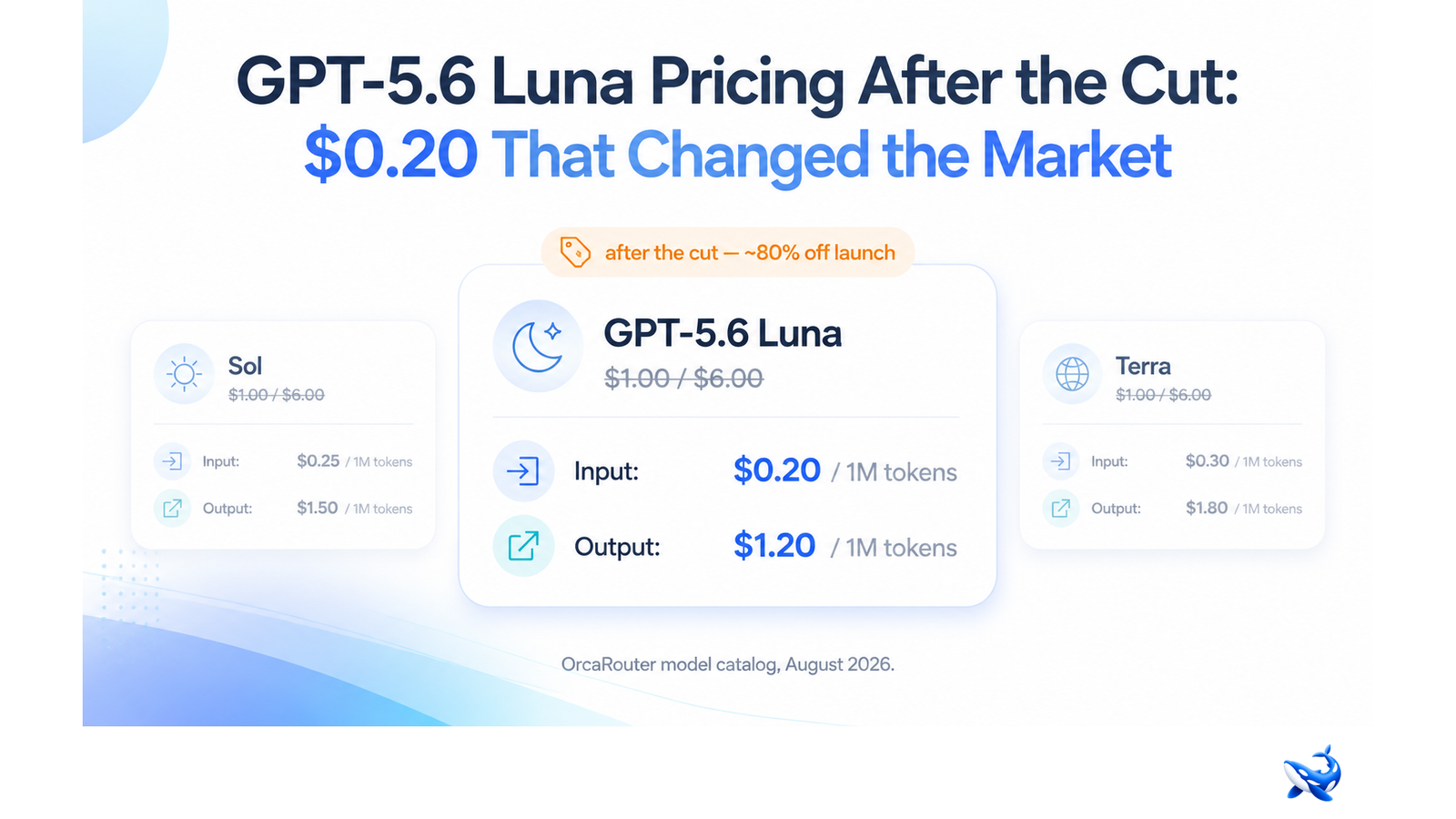
GPT-5.6 Luna API after the cut is the simplest rate card on the frontier: $0.20 per million input tokens and $1.20 per million output — an ~80% reduction from the $1.00 / $6.00 launch rate. That single number moves Luna from “economy tier” to a cost structure that changes how teams budget for high-volume AI traffic, and GPT-5.6 Luna is the live, always-current version of those numbers. This is the straight version: what the cut actually buys, where the math holds up, and where it gets complicated.
The pricing story here deserves its own framing, because price cuts for frontier models usually arrive as a footnote on a release page. This one didn’t. A ~80% cut on a model that was already OpenAI’s economy tier — released July 9, 2026, per Artificial Analysis’ model registry — makes Luna cheaper per input token than models that were themselves famous for being cheap. The interesting question is no longer “is it affordable.” It is “what exactly are you buying, and what are you trading away at $0.20.”
The rate card after the cut
The post-cut figures, as reflected in OrcaRouter’s model catalog and its openai-api-price-cut-gpt-5-6 analysis [OURS — OrcaRouter]: input $0.20 / 1M, output $1.20 / 1M, down from the launch price of $1.00 / $6.00 — a cut of roughly 80% on both sides. The cut is not a marketing number that sits on a blog post; it is passed through to the actual rate card, so the unit economics you read are the unit economics you pay.
Luna is one member of a three-tier family, and the cut only hit part of it. Here is where the family landed after the change, per OrcaRouter’s tier analysis [OURS]:
| Tier | Role | Input / 1M | Output / 1M | Change vs launch |
| Sol | flagship | $5.00 | $30.00 | unchanged |
| Terra | balanced default | $2.00 | $12.00 | ~20% off (from $2.50 / $15.00) |
| Luna | economy / high-volume | $0.20 | $1.20 | ~80% off (from $1.00 / $6.00) |
So OpenAI re-price the family asymmetrically: the top tier stay exactly where it was. The middle tier got a modest trim, and the bottom tier got cut to a fifth of its launch cost. That is the part that matters for anyone doing volume — the gap between “default tier” and “Luna tier” is now tenfold on input, and the gap between flagship and economy is twenty-fivefold.
What $0.20 buys
At $0.20 per million input tokens you might expect a crippled model. The independent benchmarks say otherwise.
Luna carries a 1,000,000-token (1M) context window, per Artificial Analysis’ contextWindowTokens field [INDEPENDENT]. It is multimodal — text and image input, text output — with closed, proprietary weights, and AA flags it as “notably fast.”
On the live Artificial Analysis board (checked August 22, 2026), Luna’s max effort configuration scores 52.32 on the Intelligence Index [INDEPENDENT] — well above the tier median of 17, and only ~8.6 points behind GPT-5.6 Sol (60.93) and ~11 points behind Claude Opus 5 (63.05), both at max. Median output speed is 156.6 tokens/sec [INDEPENDENT], which is among the fastest on the board — Opus 5 sits at 61.8 and Sol at 73.7. First-token latency on AA is around 102 ms [INDEPENDENT]. Dial the effort down from max (52.32) to xhigh (50.06) to high (46.96) and you trade a few index points for even faster, cheaper calls.
Our own telemetry backs up the “volume workhorse” read. Over a 7-day window, OrcaRouter logged 21,271.6M tokens of Luna traffic in 7 days [OURS — OrcaRouter] — by far the highest-volume model in the telemetry set — with p50 time-to-first-token of 1.33 s and p95 of 7.32 s [OURS]. For contrast, Claude Opus 5 in the same window did 491.5M tokens with a 7.34 s p50. People are not moving to Luna because it’s cheap; they’re moving to it because it’s cheap and fast enough to carry real production load.
The cost-per-task reality
The trap in any pricing article is judging a model by its per-million price while it is actually a reasoning model that bills deliberation as output. Artificial Analysis runs a fixed set of tasks across every model it tracks, and its numbers are the cleanest way to see the real unit economics.
On the live AA board, running its Intelligence Index costs $0.05 per task with Luna [INDEPENDENT] — the cheapest on the entire board. Evaluating the full index consumed 130M output tokens and cost $172.17 [INDEPENDENT], where the tier median burns around 60M. Overall, Luna ranks #21 of 172 models by cost [INDEPENDENT]. Cheap isn’t a stretch; it’s the position.
The interesting part is the price-vs-intelligence tradeoff. Claude Opus 5 scores higher (63.05 at max) but costs $2.34 per Intelligence Index task [INDEPENDENT] — roughly 47× Luna’s $0.05. GPT-5.6 Sol scores 60.93 but costs $1.23 per task [INDEPENDENT], about 25× more. Luna gives you 52.32 points of measured intelligence for the cheapest per-task price on the board. If your workloads are high-volume, self-contained, and forgiving of a ~10-point gap, the arithmetic is overwhelming: you can spend the same budget and get roughly two orders of magnitude more completed tasks.
The listing conflict, and the pass-through
One thing worth flagging before you budget: pricing for Luna is not identical on every listing. A single outside listing quoted the model at $0.10 / $0.60 with a separate tier above 272k prompt tokens, while OrcaRouter’s catalog and Artificial Analysis both read $0.20 / $1.20. We’re not picking a side here the honest summary is that pricing varies by listing, and our reference is the cut price passed through at 0% markup.
That last part is the operational point. However you buy access — through the vendor’s own API or several third-party platforms — a markup on top of the rate card quietly undoes the entire cut. A 0% markup pass-through means the vendor’s price change reaches you the day it happens, not a quarter later, and a model that got 80% cheaper stays 80% cheaper on the bill. On OrcaRouter, Luna is live as openai/gpt-5.6-luna on an OpenAI-SDK-compatible surface, so the rate card above is what you actually pay [OURS — OrcaRouter]. Replit’s Free Mode now runs on Luna per OpenAI’s own positioning [VENDOR], which tells you how comfortable the ecosystem already is treating it as the cheap default.
One more consequence of the cut worth naming: it resets expectations for what “economy tier” means across the whole market, not just within OpenAI’s lineup. When a flagship-lab economy model at $0.20 per million input tokens is the going rate for volume, every other vendor’s budget tier is being measured against that number — and the teams that win the next procurement cycle are the ones whose routing setup can actually take advantage of a price cut the day it lands, rather than the quarter after the contract renews.
The takeaway
Luna at $0.20 / $1.20 is the right choice for a specific profile: high token volume, agentic or extraction-heavy workloads where a ~10-point intelligence gap to Sol or Opus 5 is acceptable, and a hard budget per completed task. It is the wrong choice for frontier-grade reasoning you can’t afford to degrade, or for teams that never look past per-million pricing to the per-task denominator that actually moves their bill. Budget in tasks, keep the 1M context in mind when designing your prompts, and if a listing quotes you anything other than $0.20 / $1.20 for the same model, ask who’s eating the markup.
Sourcing note: pricing, the price cut, and family-tier figures are OrcaRouter’s catalog and openai-api-price-cut-gpt-5-6analysis [OURS]; Intelligence Index, context window, speed, latency, and cost-per-task figures are from Artificial Analysis’ live model pages (checked August 22, 2026) [INDEPENDENT]; the Replit Free Mode claim is OpenAI’s own [VENDOR]; latency and traffic figures are OrcaRouter telemetry over a 7-day window [OURS]. Vendor pricing changes without notice; where listings disagree, our reference is the post-cut price passed through at 0% markup.