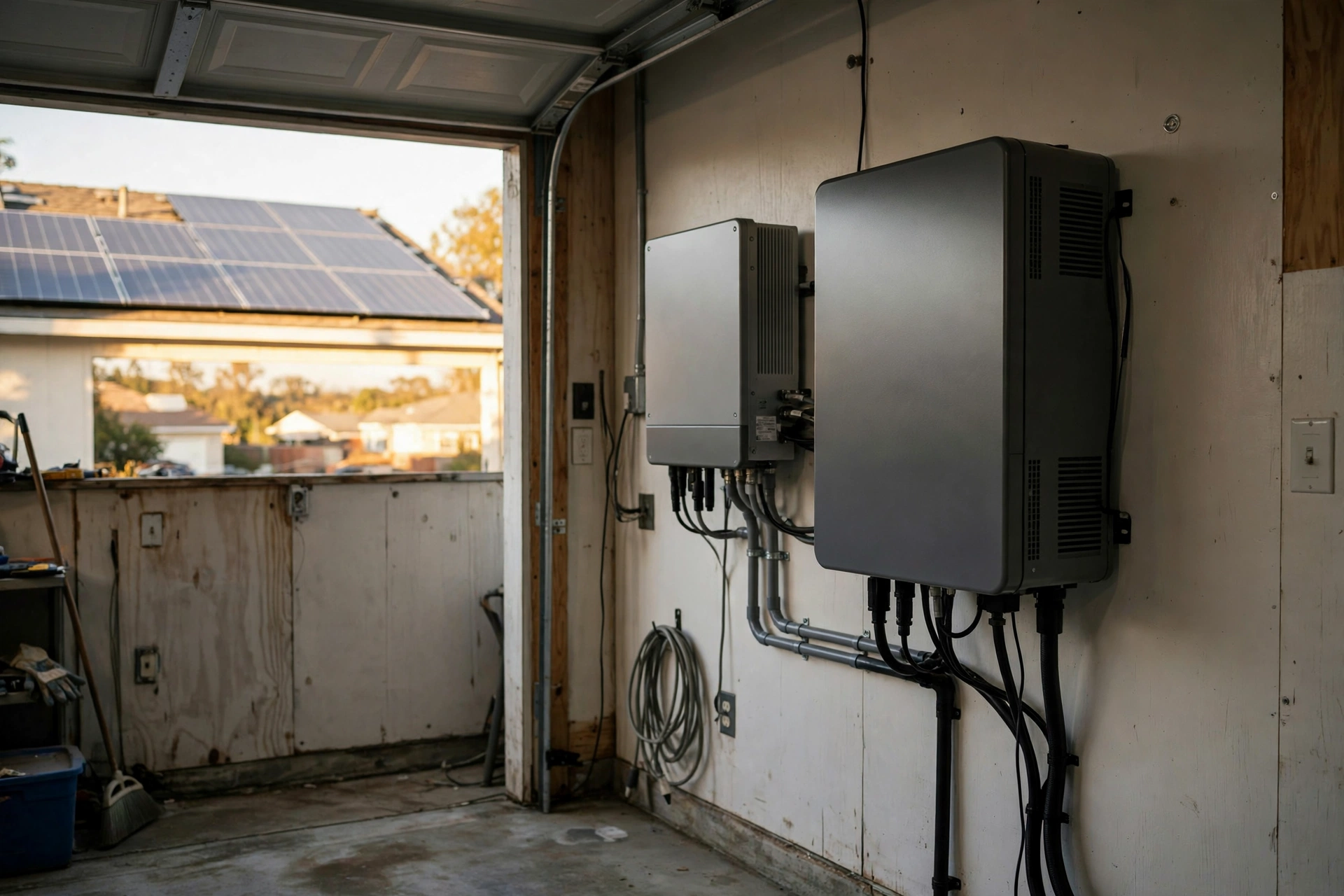
Two neighbors can install identical batteries and judge them by opposite standards. One wants to stop exporting midday solar for pennies and buy less at night. The other lives where storms knock out the grid and wants the refrigerator running for two days. A third, miles from the nearest line, wants a battery that never lets the lights go out. The hardware may look the same on the wall, but the sizing logic, the settings and the definition of success are different in each case. Getting that distinction right is the fastest way to avoid disappointment with residential solar energy storage, so it is worth laying out the three jobs side by side.
Why storage is becoming a default
The shift is visible in the numbers. Lawrence Berkeley National Laboratory reported that battery storage was paired with 37 percent of new U.S. residential solar installations in 2025, up from 25 percent in 2024. In California the figure was about 74 percent, up from 58 percent. Wood Mackenzie later put the national residential solar-plus-storage attachment rate at 46 percent in the second quarter of 2026, compared with 41 percent a year earlier. The Berkeley report cautions that its figures leave out batteries added to existing systems and standalone installations, so the true share of homes buying storage is likely higher than attachment rates alone show. These percentages describe how often batteries are bought, not why. The "why" splits into three motives.
Job one: solar self-consumption
The goal is to shift surplus daytime generation into the evening. Success is measured in kilowatt-hours that you avoided buying, so what matters is daily energy throughput. A battery that cycles once a day, every day, will accumulate cycles fast, which makes cycle life and round-trip efficiency the specifications that decide long-term value. Peak power matters less, because evening household demand usually involves modest simultaneous loads.
Job two: backup during outages
Here the battery mostly waits. It earns its keep during a handful of events a year, so energy per year is small and reliability is everything. The U.S. Energy Information Administration reported that the average American electricity customer experienced about 11 hours of interruptions in 2024, nearly twice the previous decade's average. Roughly nine of those hours came from major weather events, while ordinary outages not tied to major events averaged about two hours a year. Averages hide enormous spread: customers in South Carolina averaged around 53 hours, while several states saw under two.
That gap is the lesson. A national average of 11 hours says little about your feeder. Backup sizing should be built from your local outage history and from the loads you refuse to lose. Key questions become:
- Which circuits are essential: refrigeration, lighting, communications, medical equipment, a well pump?
- What is the starting surge of the largest motor?
- Does the system switch over fast enough for equipment that dislikes interruptions?
- Can solar recharge the battery during a multi-day outage?
Job three: off-grid living
With no grid to fall back on, the battery is the foundation of the house, and the design question flips. Instead of asking what the battery can run during an outage, you ask how many cloudy days the system must ride through. That is called autonomy. The calculation links daily household energy, battery capacity, solar array size and, often, a generator as the last resort. Charging capacity gets as much attention as storage, because a big battery that cannot refill in winter becomes a very expensive paperweight.
The three jobs compared
| Self-consumption | Backup | Off-grid | |
|---|---|---|---|
| Battery use | Daily cycling | Occasional deep use | Daily cycling, sometimes deep |
| Deciding specification | Cycle life, efficiency | Output power, reliability, reserve settings | Capacity, charging input, autonomy |
| Typical sizing driver | Evening energy use | Essential loads and outage length | Worst-month solar vs. household demand |
| Failure looks like | Poor payback | Dark house in a storm | Dark house in a week of clouds |
| Practical setting | Maximize cycling | Keep a reserve in the battery | Protect depth of discharge |
Combining jobs without confusing the system
Most homes want two jobs at once, and the conflict is real. If the battery is drained every evening for self-consumption, nothing is left when the grid fails at 9 p.m. Good systems resolve this with a reserve setting: a percentage held back for backup, with the remainder available for daily shifting. Raising the reserve improves resilience and lowers savings. Choosing that number is a personal judgment about how much you value the outage insurance.
Matching equipment to the job
Compact integrated units of roughly 2 to 6.4 kWh with a built-in inverter, solar input and several AC outlets fit selective backup and small off-grid cabins well. They are less suited to whole-home independence, since the median battery paired with new U.S. residential solar in 2025 was 13.5 kWh, per the Berkeley data. When the target is a full household load, the realistic options are larger or modular systems, with a proper inverter and charge controller sized to the array. Whatever the scale, evaluate PV input, charging capacity, battery specifications and inverter compatibility together, because a weak link in any one of them limits the whole system.
Short FAQ
Can one battery do self-consumption and backup? Yes, with a reserve setting that holds back energy for outages.
Does a bigger battery always help? Only if it can be recharged. Charging capacity and available sun set the practical ceiling.
Should I size for the worst outage I can imagine? Size for the loads and durations you consider essential, then add a generator or a second charging source for the rare long event.
Conclusion
Before comparing models, decide which of the three jobs you are hiring the battery to do. That single decision tells you which numbers on the spec sheet deserve your attention and which can be ignored.