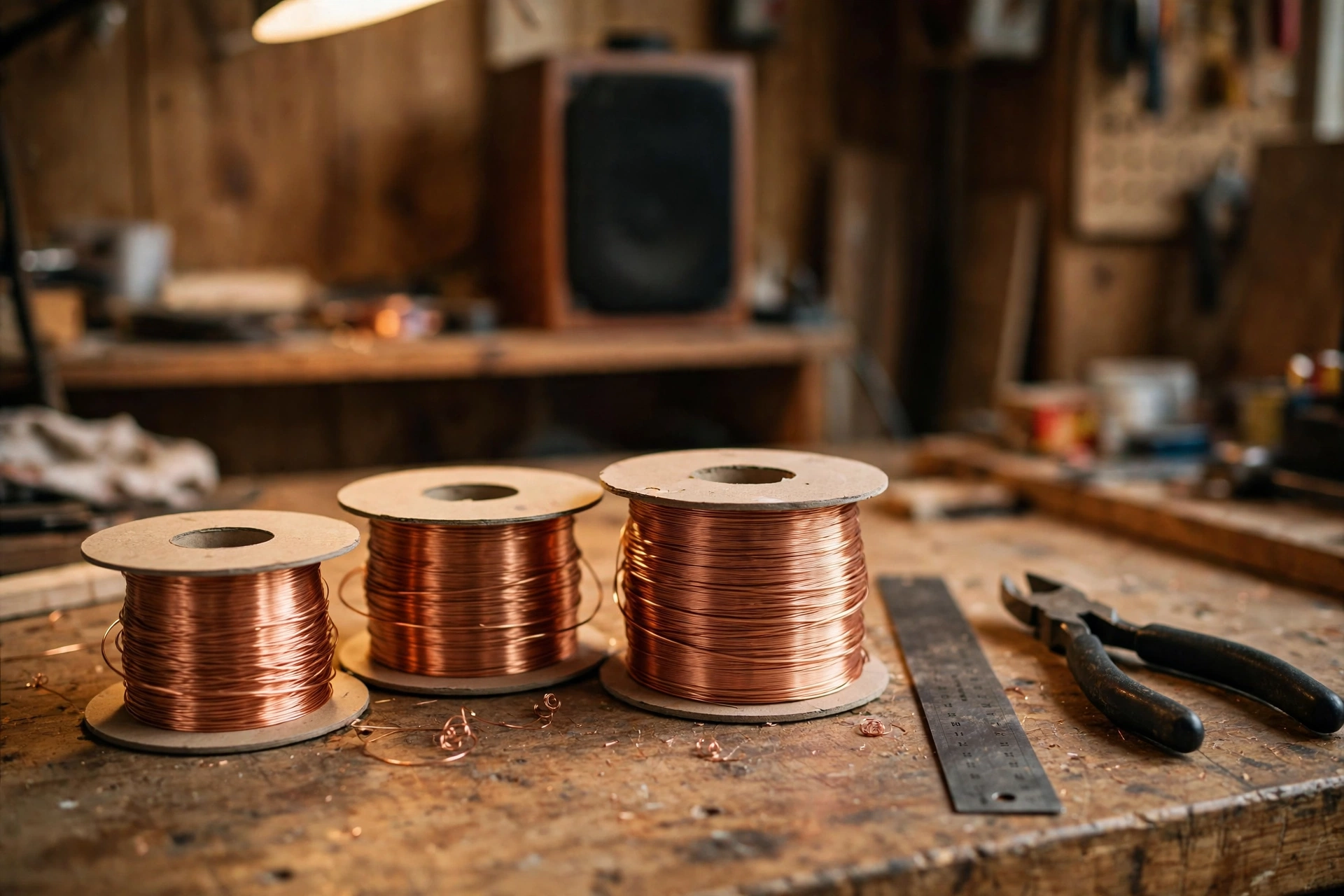
Stand in front of a wall of speaker wire and the choice seems to be about colour, thickness and price. Electrically, the question is much narrower: how much resistance are you putting between the amplifier and the speaker? Answer that, and most of the confusion disappears.
The three things that decide gauge
Distance. Resistance rises with every metre. The current travels out on one conductor and back on the other, so a 5 m run contains 10 m of wire.
Speaker impedance. A 4 ohm speaker is more sensitive to cable resistance than an 8 ohm model.
Conductor size and material. In the American Wire Gauge (AWG) system, a smaller number means a thicker wire.
A widely used guideline is to keep the total resistance of the cable below 5% of the speaker's rated impedance. That means under 0.2 ohm for a 4 ohm speaker, 0.3 ohm for 6 ohm and 0.4 ohm for 8 ohm.
Maximum run length chart
These figures are calculated for copper at 20 °C using standard AWG resistance values and the 5% guideline. Length means the distance from amplifier to speaker.
| Wire size | Resistance per metre, one conductor | 4 Ω | 6 Ω | 8 Ω |
|---|---|---|---|---|
| 18 AWG | 20.9 mΩ | 4.8 m | 7.2 m | 9.6 m |
| 16 AWG | 13.2 mΩ | 7.6 m | 11.4 m | 15.2 m |
| 14 AWG | 8.28 mΩ | 12.1 m | 18.1 m | 24.2 m |
| 12 AWG | 5.21 mΩ | 19.2 m | 28.8 m | 38.4 m |
Connectors add a little resistance of their own, so leave a margin rather than running right to the limit.
What the limit sounds like in numbers
At exactly 5%, the level lost in the cable is about 0.42 dB. That is a modest figure. If you want to be stricter, halve the lengths in the chart and the loss falls to roughly 0.21 dB. Some reviewers, Audioholics among them, recommend tighter targets of this kind for critical listening. Consider a practical case. A 10 m run to a 4 ohm speaker using 18 AWG has about 0.42 ohm of loop resistance, more than twice the 0.2 ohm target. The same run in 14 AWG has about 0.17 ohm and sits comfortably inside it. Now take a desktop setup with 1 m leads. Even 18 AWG adds only about 0.04 ohm. Buying very thick wire here changes little electrically and may be harder to fit into small terminals.
The label trap: copper clad aluminium
Copper clad aluminium (CCA) is aluminium wire with a thin copper skin. It is cheaper and lighter than copper, but its resistance is higher. As a rule of thumb, treat CCA as performing like copper two AWG sizes thinner. A 14 AWG CCA lead should therefore be judged roughly like 16 AWG copper. Read the packaging carefully. If a listing gives a gauge but no conductor material, ask before buying. Oxygen free copper (OFC) is a refined grade of copper. For choosing a size, gauge and length remain far more important than the difference between ordinary copper and OFC.
Wire inside walls is a different purchase
A patch lead behind a cabinet and cable hidden in a wall are not the same product. In the United States, in-wall speaker wiring generally calls for a fire rated jacket such as CL2 or CL3, with further requirements for plenum spaces and some vertical runs. Other countries have their own codes. Check the local rule or ask a qualified installer before closing up a wall.
A quick selection routine
- Check the impedance printed on the back of each speaker.
- Measure the real cable route, including corners and slack.
- Find the thinnest gauge in the chart that covers that length with margin.
- If the conductor is CCA, choose two sizes thicker than the copper figure.
- Confirm that the wire or plug fits both the amplifier and speaker terminals.
- For short runs, a ready terminated stereo speaker cable can save stripping and twisting, provided its stated gauge, length and plug size match your equipment.
Common questions
Must the left and right cables be the same length? Not for timing. Signals cross a few metres far too quickly for you to notice. Similar gauge and reasonably similar length keep the two resistances close.
Is thicker always better? Only up to a point. Once resistance is low relative to the speaker, further thickness brings diminishing returns.
Does a higher power amplifier need thicker wire? Power matters for heating, but in ordinary home setups the resistance guideline is usually the tighter constraint over longer runs. Check the manual for any stated wire size.
The best choice is rarely the most expensive reel on the shelf. It is the one whose gauge suits your distance and your speakers.