Federal crash data makes an uncomfortable point about roadwork. According to a Federal Highway Administration fact sheet, 905 people died in US work zone crashes in 2023 and 850 in 2024. In 2024, 22 percent of those fatal crashes (169 of them) involved a rear end collision, and speeding was a factor in 34 percent. A separate FHWA summary, reported by Occupational Health & Safety, said about half of the fatal work zone crashes in 2023 happened at night. Rear end crashes are a detection problem as much as a speed problem. A driver who notices a closed lane or an unprotected hazard two seconds too late has already lost the argument with physics. Warning lights exist to pull that moment of recognition further up the road.
Three types of light, three different jobs
Many work zone specifications in the United States point to the ITE standard for barricade warning lights, which sorts them into three types. A state work zone guide describes the roles plainly: low intensity flashers warn of an isolated hazard at night, high intensity flashers work day and night, and steady burn lights are used in a series to mark the edge of the travelway.
| Type | Behavior | Flash rate | Minimum effective intensity | Typical job |
|---|---|---|---|---|
| A, low intensity | Flashing | 55 to 75 per minute | 4 candela | Night warning of an isolated hazard |
| B, high intensity | Flashing | 55 to 75 per minute | 35 candela | Day and night, isolated hazards or advance warning signs |
| C, steady burn | Constant | Not applicable | Set by local specification | Night, in a series, to mark the travelway edge |
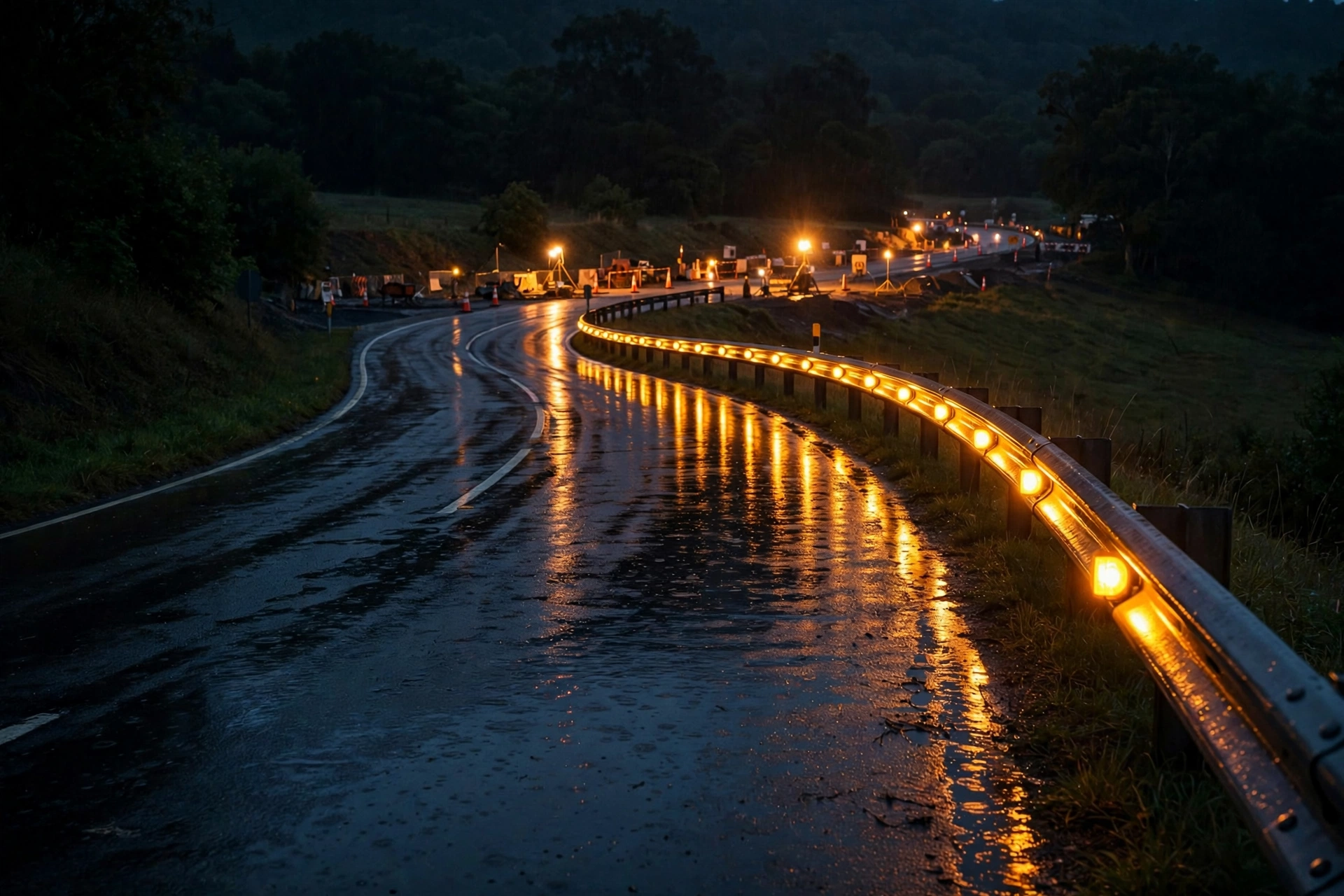
Notice that only Type C is meant to work as a row. Flashing lights, by design, mark a point. That is where synchronization changes the picture. When a dozen amber lights flash out of step along a curve, the eye catches scattered blinks and has to work out what they mean. When the same dozen flash together, the pattern reads as one continuous line that follows the road. This is an engineering argument, not a measured result, and agencies should check how their own specifications treat synchronized flashing. It does explain why wireless sync has become a common feature in this equipment category.
What a synchronized solar unit actually offers
One product in this category, the Handheld Solar Warning Light, shows the typical design choices. It charges a lithium battery from a top mounted solar panel, so there is no cable to trench, strike or steal. Its listed specifications include:
- 13 yellow LEDs behind a Fresnel style lens
- 2.4 GHz wireless synchronization, with a stated range of more than 100 meters between adjacent units
- A stated visibility distance above 500 meters
- Button selected modes including steady, strobe and breathing
- Listed runtime of roughly 50, 71 and 48 hours on a full charge, depending on the synchronized mode
- Operating range of minus 20 to plus 65 degrees Celsius
- A body of about 143 by 132 by 66 millimeters, with a sleeve that fits onto cones or posts
Reading the numbers with a critical eye
Three details deserve a question before a purchase order. First, the listed flash rate is 50 per minute, customizable. That sits below the 55 to 75 range found in ITE based specifications for Type A, so a contract that cites ITE will need the rate adjusted and documented. Second, no candela rating is published, which means the unit cannot be classified as Type A or Type B on paper. Ask for photometric test data. Third, the 100 meter sync range is the real spacing limit for a chain of lights. Visibility range tells you how far a driver can see one light, while sync range tells you how far apart you can place neighbors without breaking the pattern. Runtime is easier to reason about. At the listed 71 hours in synchronized strobe, a unit working a twelve hour night would last close to six nights from a full charge before the panel has to catch up. That is simple arithmetic on the manufacturer's figure, and real results will vary with cloud cover and panel condition.
Where this kind of light earns its place
- Highway curves where the sight line closes before the hazard does
- Guardrail edges and cliffside sections without mains power
- Fog prone stretches, where the maker points to yellow light's ability to cut through rain and fog
- Temporary closures that move often, since a sleeve mounted unit can be recovered and reused at the next site
Quick answers
Do solar warning lights work on overcast days? They run from stored charge, so the listed runtime is the buffer. A week of heavy cloud can still drain a battery, so check how quickly a unit recovers, not just how long it lasts.
Can a solar flasher replace a Type B light? Only if its photometric data meets the Type B intensity your specification requires. Brightness claims on a product page are not a substitute for test results.
Is a handheld form better than a post mounted one? It depends on the site. Handheld bodies suit cones and portable posts. Fixed guardrail runs may be better served by a bracket mounted version.